Head Office
Email: info@sat-e.com
Phone : (+91 ) 9075855800
Pune Office
Email: hr@sat-e.com
Phone : (+91 ) 9112966239
Start Your Learning Journey !! Connect with Us Now !!
SAT-E Solutions “Education for Employment”

Head Office
Email: info@sat-e.com
Phone : (+91 ) 9075855800
Pune Office
Email: hr@sat-e.com
Phone : (+91 ) 9112966239
Start Your Learning Journey !! Connect with Us Now !!
SAT-E Solutions “Education for Employment”
To-Do List Application with Flask/Django and database integration
Online E-commerce platform with product listing, cart, and checkout
Blog application with user authentication and CRUD operations
REST API project integrated with frontend JavaScript/React
Full-stack capstone project simulating a real-world application
REST API with JWT authentication
File uploads and media handling
WebSockets for real-time applications
Introduction to Docker and containerization for deployment
Unit testing and automated testing in Python
Project structure, modular coding, and best practices
CRUD operations implementation (Create, Read, Update, Delete)
User authentication, role-based access, and security basics
Error handling, logging, and debugging techniques
Deployment of web apps to cloud servers or hosting platforms
Advanced JavaScript and ES6 features
AJAX, Fetch API, and API integration
Frontend frameworks (optional): React.js or Vue.js basics
Connecting frontend with Python backend APIs
Introduction to Flask and Django frameworks
Routing, request handling, and templates
RESTful API design and implementation
Middleware, authentication, and session management
Database integration: SQL and NoSQL (PostgreSQL, SQLite, MongoDB)
ORM (Object Relational Mapping) with SQLAlchemy / Django ORM
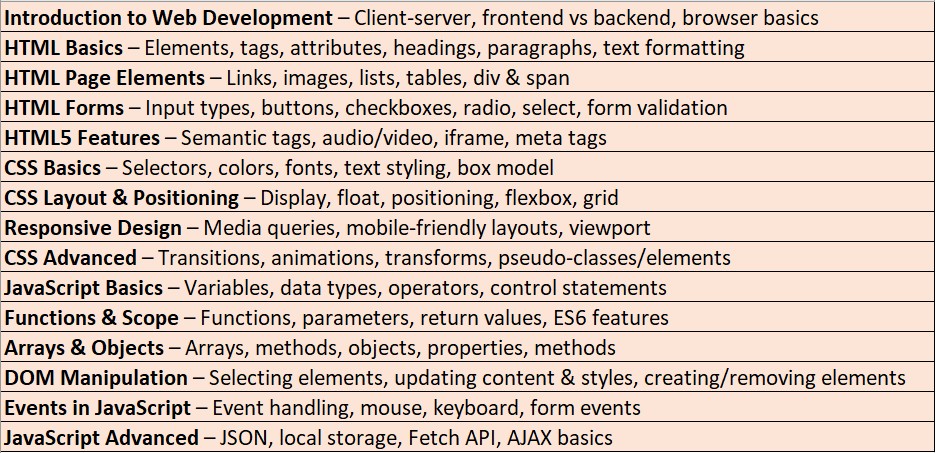
Introduction to web technologies: HTML, CSS, and JavaScript
Responsive design and layout using CSS and Flexbox/Grid
DOM manipulation, events, and JavaScript fundamentals
Client-server architecture basics
Python setup, IDEs, and environment configuration
Variables, data types, operators, and expressions
Control flow: conditional statements and loops
Functions, lambda functions, and modular programming
Data structures: lists, tuples, dictionaries, sets, and comprehensions
File handling, JSON, and CSV operations
Object-Oriented Programming (OOP): classes, objects, inheritance, polymorphism, encapsulation
Hands-on projects across domains: Finance, Healthcare, E-commerce, Media, Recommendation Systems
End-to-end capstone project combining ML, Deep Learning, and GenAI
Industry-grade problem solving and application deployment
Building AI applications with Flask
Frontend basics: HTML, CSS, JavaScript integration
Data storage & querying using SQL
Version control with Git & GitHub
Deploying AI solutions with Docker and Kubernetes
Introduction to Generative AI and Large Language Models (LLMs)
Natural Language Processing (NLP) fundamentals
Generative models: GANs (Generative Adversarial Networks)
Retrieval-Augmented Generation (RAG) for smart AI solutions
Agentic AI tools: Cursor AI, GitHub Copilot, Claude
Neural networks concepts: perceptron, forward & backward propagation
Architectures: Feedforward (FNN), Recurrent (RNN), LSTM, Convolutional (CNN), Transformers
Frameworks: PyTorch, TensorFlow, Keras
Applying deep learning for image, sequence, and text data
Mathematical foundations: statistics, probability, linear algebra, calculus
Supervised learning: classification and regression
Algorithms: Linear & Logistic Regression, Decision Trees, KNN, Naive Bayes
Unsupervised learning: clustering, dimensionality reduction, association analysis
Algorithms: K-Means, DBSCAN, PCA
Reinforcement learning fundamentals
Model evaluation: precision, recall, F1 score, bias/variance tradeoff
Tools: Scikit-learn, Kaggle datasets
Python basics: variables, operators, loops, and conditional statements
Functions and lambda expressions
Data structures: lists, tuples, dictionaries, sets, and list comprehensions
File handling and working with JSON
Object-Oriented Programming (OOPs) concepts
Data collection, cleaning, preprocessing, and visualization
Libraries: Numpy, Pandas, Matplotlib, Seaborn
In the Project Development module, students apply the knowledge and skills they have learned throughout the Java Full Stack course to build real-world, industry-relevant applications. This hands-on module helps learners understand the complete software development lifecycle, from requirement analysis to deployment.
Students will work on end-to-end projects involving:
Designing application architecture and database schema
Developing frontend using HTML, CSS, JavaScript
Implementing backend logic using Java, Spring, and Spring Boot
Connecting the application with databases using JDBC and Hibernate
Creating REST APIs and integrating frontend with backend
Performing testing and debugging to ensure functionality
Deploying projects on servers or cloud platforms
By the end of this module, learners will have fully functional projects that demonstrate their ability to develop complete applications. These projects can be used as portfolio work, giving students an edge in job interviews and professional careers as Full Stack Developers.


| Introduction to Enterprise Java Frameworks
Understanding Framework Architecture |

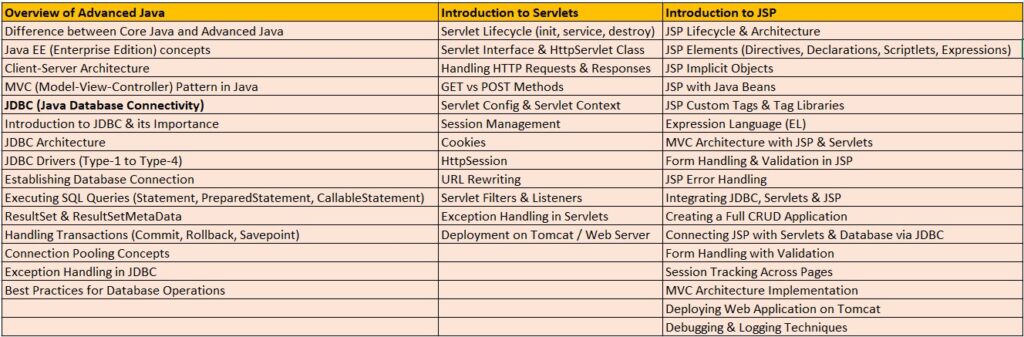
Advance Java Topics: